Categories

Showing posts with label Postal History. Show all posts

Monday, December 25, 2017

Early Rural Free Delivery Mail Service Covers


R.F.D. - Rural Free Delivery was, in its day, one of the great social equalizers bringing to rural America something that had been enjoyed by urban America for years, delivery of the mail. John Wanamaker, of the Philadelphia Department Store fame, who served as Postmaster General from 1889 to 1893 had the very logical idea that it made more sense for one person to deliver mail than for 50 people to ride into town to collect their mail. He cited business logic and social philosophy as reasons to give rural dwellers free delivery


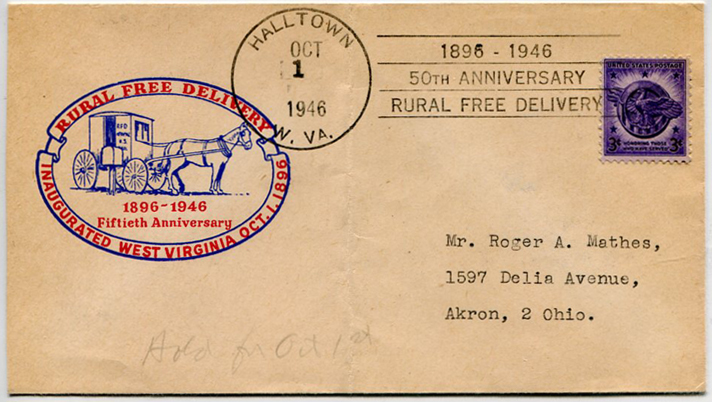
Of equal significance was the political pressure of the National Grange, National Farmers’ Congress, and State Farmers’ Alliance advocating for the farmers and rural America. The actual implementation of Rural Free Delivery came about under the administration of William L. Wilson, Postmaster from 1895 to 1897. On October 1, 1896, rural free delivery (RFD) service began in Charles Town, Halltown, and Uvilla in West Virginia, Postmaster General Wilson’s home state.

Since the RFD carriers simply delivered mail and picked it up to take to the post office in town, these early letters do not carry postal markings to identify them as RFD mail.

 However, in August 1900 carriers began marking the mail picked up on their routes with pencil cancels. Within a few years carriers were outfitted with rubber stamps bearing R.F.D. the post office town name and the date plus a bar cancel and a number (known as a Doane Cancel). Use of these cancelling devices was discontinued by June of 1903.

Postal bureaucracy was simpler in those days, but just as important, as the charge to be responsible for the mail was to be taken seriously. Here is a page from the Form 1977 of June, 1913 entitled INSTRUCTIONS TO APPLICANTS FOR THE RURAL CARRIER EXAMINATION. Included is a listing of the possible reasons for not being considered to be admitted to the exam, including a person not a citizen or not owing allegiance to the United States, handicapped persons including insanity, epilepsy, and TB, or one addicted to the habitual use of intoxicating beverages to excess.

Those persons chosen to take the examination and passing signed a CERTIFICATE OF THE OATH OF MAIL CONTRACTOR AND CARRIERS required by Act of Congress of March 5, 1874

Tendering ones resignation from the post of rural letter carrier was done with the Post Office Department form 2520-P which was mailed as official Business bearing penalty mail postage exemption.

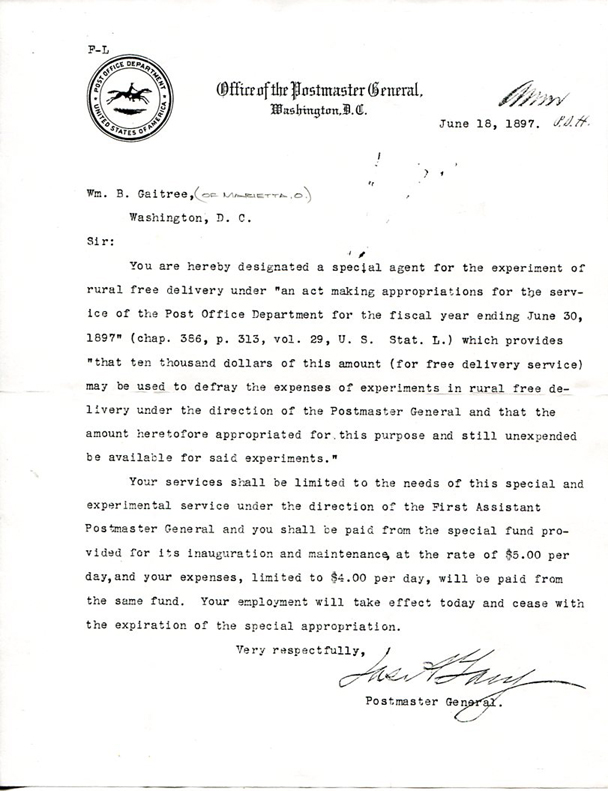
Finally, here is a photocopy of a letter from the Postmaster General in 1897 to a Wm.B. Gaitree designating Mr. Gaitree a special agent for the experiment of rural free delivery. Payment is to be $5.00 per day plus up to $4.00 per day for expenses. Employment will cease with the expiration of the special appropriation  intended to fund the experiments in rural free delivery.
History is littered with postal and other enterprises that foundered on the rocks of an administration change caused by a different party taking office, RFD survived and expanded beyond humble beginning in West Virginia until in 2012, nearly 41 million homes and businesses were served by the Postal Service’s rural letter carriers.

Monday, September 23, 2013

California History: Why a cover is worth a thousand words


California History:  Why a cover is worth a thousand words

From one small piece of Postal History comes a large amount of California history. The piece in question is a February 23rd 1868 envelope mailed from Los Angeles to the State Treasurer in Sacramento, delivered by the storied Wells Fargo & Company.

The recipient of the mail is a man who as much as anyone personifies the history of California.  Antonio Francisco Coronel, born in Mexico City in 1817, came to California in 1834 at the age of 17.

In 1821 as Mexico (including California) gained independence from Spain, the new nation of Mexico granted large tracts of land to the original “Californios”.  Coronel was granted lands in Los Angeles around what is today 7th and Alamedia in South-Central. On his land grant Coronel planted one of California’s first orange groves, so important to the agricultural and commercial future of Southern California.

 In 1847 Coronel joined the Mexican Army forces lead by General Andreas Pico to battle against the United States’ annexation of California The U.S. forces were lead by Generals Fremont and Stockton.

In 1848 news of GOLD! in what became the Mother Lode of California hit Los Angeles. much earlier than the news hit the rest of the country, as would be expected in the world before Twitter. On March 2 Coronel left Los Angeles with a group of about 30, including servants. They rode to San Jose and then into the foothills of the Sierras where small fortunes were made In August Coronel began to dig. The first day he got 45 ounces of gold. The next he got 38 ounces. And, as they say, the rest is history.

Successful agriculturalist, landed gentry and a gold rush fortune to boot, Coronel gained United States Citizenship and became a major contributor to the development of his State of California. He was elected Country Assessor in 1850. In 1853 he was elected Mayor of Los Angeles, helping to initiate public education in his city.

In 1868 Coronel was elected State Treasurer. To his office in Sacrament, Wells Fargo & Co. delivered the envelope shown above.

Mail deliveries by the U.S. Postal Service were still uncertain and slow in 1868. But letters were allowed to be carried outside the mails as long as they were contained in a government envelope with the proper postage. So Post Office Embossed Envelopes, known as Postal Stationery to collectors, were used to verify that the appropriate postage has been paid.

Wells Fargo became the most reliable and rapid means for the transportation of mail between Los Angeles and northern California. This service was provided by coastal steamer or the ‘daily’ stagecoach. There were no postal markings applied to tell us which means was used for a particular letter. But Wells Fargo printed their indicia on the envelope to indicate that they had collected their fee for the service provided, in addition to the postage.

Thus, from one envelope delivered by Wells Fargo & Co. in 1868 we get a history lesson spanning California from Spanish to Mexican to American rule, battles and gold, civic and agricultural progress, and a gem to the eye of a collector.


Sunday, June 2, 2013

 U.S. Frigate Constitution Cacheted Covers

 USS Constitution: Washington DC Beautiful engraving cachet, only 35 covers were produced
After a renovation project costing $985,000 to replace decayed timbers and extensive additional support for the hull, the famous fighting ship "Old Ironsides" was back to fighting form. The new cannons were replicas, but much more authentic in appearance than the replica-cannon installed in 1907.

On July 2, 1931, USS Constitution and a crew of 81 sailors, officers, and Marines cast off on a three-year, three-coast tour around the United States. This National Cruise was a public "thank you" to the men, women, and children who, from 1925-1930, helped raise over $985,000 to fund the renovation.

Under Commander Louis J. Gulliver, "Old Ironsides" traveled 22,000 miles, visited 90 ports, and welcomed more than 4.5 million visitors; over two million in California alone. The tour began up the East Coast as far north as Bar Harbor, ME, and then south through the Panama Canal and up the West Coast as far as Bellingham, WA,. She was towed by the minesweeper USS GREBE and, occasionally, by the submarine tender USS BUSHNELL.

Marking the events of the U.S. Frigate Constitution's visit to the many ports, an extensive number of special cachets were produced and special cancellations noting each port visited. Some stops, without harbors, are posted, for example 'OFF PORT SAN LUIS' for San Luis Obispo. The cachets are designs by the major First Day Cover artists, such as Crosby, plus special cachets sponsored by chambers of commerce and civic/patriotic groups.

 June 8th 1934 marked the date of return of 'Old Ironsides' to Boston and its docking to this day at the Boston Navy Yard.

"While she sails the seas no more,
May the spirit of 'Old Ironsides'
go sailing on!"

The legacy of the U.S. Frigate Constitution began during the War of 1812. Off the coast of Nova Scotia the ship to become known as 'Old Ironsides' defeated the British frigate Guerrière, boosting the new nations spirits and resolve, confronting the might and power of Britannia. Witnesses to the battle claimed that the British shot merely bounced off the Constitution's sides, as if the ship were made of iron rather than wood. By the war's end, "Old Ironsides" destroyed or captured seven more British ships.

The Constitution was one of six frigates that Congress authorized to be built in 1794 to help protect American merchant fleets from attacks by Barbary pirates and harassment by British and French forces. The bolts fastening its timbers and copper sheathing were provided by the industrialist and patriot Paul Revere. Launched on October 21, 1797, the Constitution was 204 feet long, displaced 2,200 tons, and was rated as a 44-gun frigate.

Its maiden voyage was in July 1798, with a crew of 450, headed for the West Indies to protect U.S. shipping from French privateers. In 1803, President Thomas Jefferson ordered the American warship to the Mediterranean to fight Barbary pirates off the coast of Tripoli. The vessel performed commendably during the conflict, and in 1805 a peace treaty with Tripoli was signed on the Constitution's deck.

In June 1812, as hostilities broke out with Britain, the Constitution was commanded by Isaac Hull, who served as lieutenant on the ship during the Tripolitan War. On July 16, the Constitution nearly meet her end as she encountered a squadron of five British ships off Egg Harbor, New Jersey. Finding itself surrounded, the Constitution was preparing to escape when suddenly the wind died. With both sides dead in the water and just out of gunnery range, a legendary slow-speed chase ensued. For 36 hours, the Constitution's crew kept their ship just ahead of the British by towing the frigate with rowboats and by tossing the ship's anchor ahead of the ship and then reeling it in. At dawn on July 18, a breeze sprang, and the Constitution was far enough ahead of its pursuers to escape by sail.

One month later, on August 19, the Constitution caught the British warship Guerrière alone about 600 miles east of Boston. After considerable maneuvering, the Constitution delivered its first broadside, and for 20 minutes the American and British vessels bombarded each other in close and violent action. The British man-of-war was de-masted and rendered a wreck while the Constitution escaped with only minimal damage. The unexpected victory of Old Ironsides against a British frigate helped unite America behind the war effort and made Commander Hull a national hero. The Constitution went on to defeat or capture seven more British ships in the War of 1812 and ran the British blockade of Boston twice.

After the war, Old Ironsides served as the flagship of the navy's Mediterranean squadron and in 1828 was laid up in Boston. Two years later, the navy considered scrapping the Constitution, which had become unseaworthy, leading to an outcry of public support for preserving the famous warship. The navy refurbished the Constitution, and it went on to serve as the flagship of the Mediterranean, Pacific, and Home squadrons. In 1844, the frigate left New York City on a global journey that included visits to numerous international ports as a goodwill agent of the United States. In the early 1850s, it served as flagship of the African Squadron and patrolled the West African coast looking for slave traders.

In 1855, the Constitution retired from active military service, but the famous vessel continued to serve the United States, first as a training ship and later as a a touring national landmark.